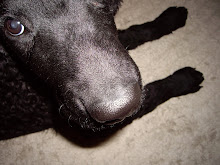
Kellie is a "bisquit whore" ( a title my dear boyfriend came up with as she´ll do anything for a treat) which also means she is very keen on being a part of the training and taking Folkes rewards. She usually comes along and I throw out a couple of hand fulls of treats on the grass and she spends her time sniffing and eating. She actually pulls to get to the lawn where we usually practise - so she thinks it's great fun.
Folke and I then practise around her - which means Folke has to roll around on treats that he is not allowed to focus on - and hasn't done this far - and he also gets a rowdy element to practise not focusing on. It's only Kellie but it's a good start, we'll have to step it up a notch and begin practising at the dog club sometime soon.
Kellie likes showing off her tricks as well, since she is more or less deaf (still being able to sort out words like food and candy though) and probably half blind it's not all that easy to communicate tricks with her but she is pretty good at the sign language.
Visar inlägg med etikett heelwork to music. Visa alla inlägg
Visar inlägg med etikett heelwork to music. Visa alla inlägg
fredag 24 april 2009


Preparing for the stage part 1. - ZickZack
Yet another trick that is mandatory in beginners class is walking between the handler´s legs. This is a little bit more tricky and it is important to use the correct leg when you start - otherwise your dog will have to go back a few steps everytime in order to avoid being kicked and to be able to walk between your legs the next time. I saw this a couple of days ago when a young girl practised with her American Cocker - it looked really strange and the dog struggled and just didn't enjoy it at all, candy or no candy -kicks are no fun.
So - the dog is placed on - say - your left side, that means that you start moving with your right leg. You have toys or candy in each hand guiding your dog to walk between your legs half way with one hand and then swopping to the other hand.
Preparing for the stage part 1. - Circle
This was Folkes first trick. Circling is not very impressive but he managed to impress some Pakistani exchange student guys down by Lake Trummen one night when I took him swimming.
He handed over the dummies like a god and shook afterwards on my command, I then had him do the circles and he got to retrieve the dummies as his reward. The Pakis were quite funny and came up to me and asked how on earth I got the dog to understand what I wanted him to do. They also said that they thought it was really strange that Swedish people brought their dogs with them everywhere as in Pakistan the only time you took your dog someplace was if you had a fighting dog and there was a competition.
We spoke for a while and I hope that Folke helped change their poor animal rights perspective at least a little bit. I think I might have hurt their masculinity though telling them to stop being such pussies around Folke - who completely ignored them and was all in on the tricks and retrieving. They were clearly not being used to any other dogs than fighting dogs and potential rabies carriers. I still think Folke got at least one inch of doubt into their stoneage values.
Circling is pretty easy to teach the dog - you use a toy or candy in front of the dog´s nose and then make a slooooow circle in the air so the dog follows your hand. Some dogs might take longer to understand that they are supposed to follow but as always the keyword is patience. I prefer to use hand plus word as that will make it easier to do the tricks from a distance but also to leave out the hand if you're up close and it doesn't suit the programme. Practice leaving out the hand some times and leaving out the word other times.
He handed over the dummies like a god and shook afterwards on my command, I then had him do the circles and he got to retrieve the dummies as his reward. The Pakis were quite funny and came up to me and asked how on earth I got the dog to understand what I wanted him to do. They also said that they thought it was really strange that Swedish people brought their dogs with them everywhere as in Pakistan the only time you took your dog someplace was if you had a fighting dog and there was a competition.
We spoke for a while and I hope that Folke helped change their poor animal rights perspective at least a little bit. I think I might have hurt their masculinity though telling them to stop being such pussies around Folke - who completely ignored them and was all in on the tricks and retrieving. They were clearly not being used to any other dogs than fighting dogs and potential rabies carriers. I still think Folke got at least one inch of doubt into their stoneage values.
Circling is pretty easy to teach the dog - you use a toy or candy in front of the dog´s nose and then make a slooooow circle in the air so the dog follows your hand. Some dogs might take longer to understand that they are supposed to follow but as always the keyword is patience. I prefer to use hand plus word as that will make it easier to do the tricks from a distance but also to leave out the hand if you're up close and it doesn't suit the programme. Practice leaving out the hand some times and leaving out the word other times.
Preparing for the stage part 1. - Rolling Around
Folke and I are getting closer to beginners class in reestyle, or Heelwork to Music as it is also called.
We haven't quite started to do the tricks to music yet but Folke is a keen pupil and learns amazingly fast so I think we'll actually have something to put together to a programme. His newest trick is to roll around which he understood after about 3 times of being told to lay down and then getting slightly pushed on his shoulder.
Next plan is to have him roll around several times in a row without getting up imbetween - haven't introduced that yet but I'm working on my body language as I think it would look pretty nice if I bend down and kind of flow with him as he rolls, which will also help him continue rolling - teaching him to get up when I stand up straight again.
Prenumerera på:
Inlägg (Atom)